
Specific kit for the qualitative, rapid and specific detection of Campylobacter jejuni in food matrices.



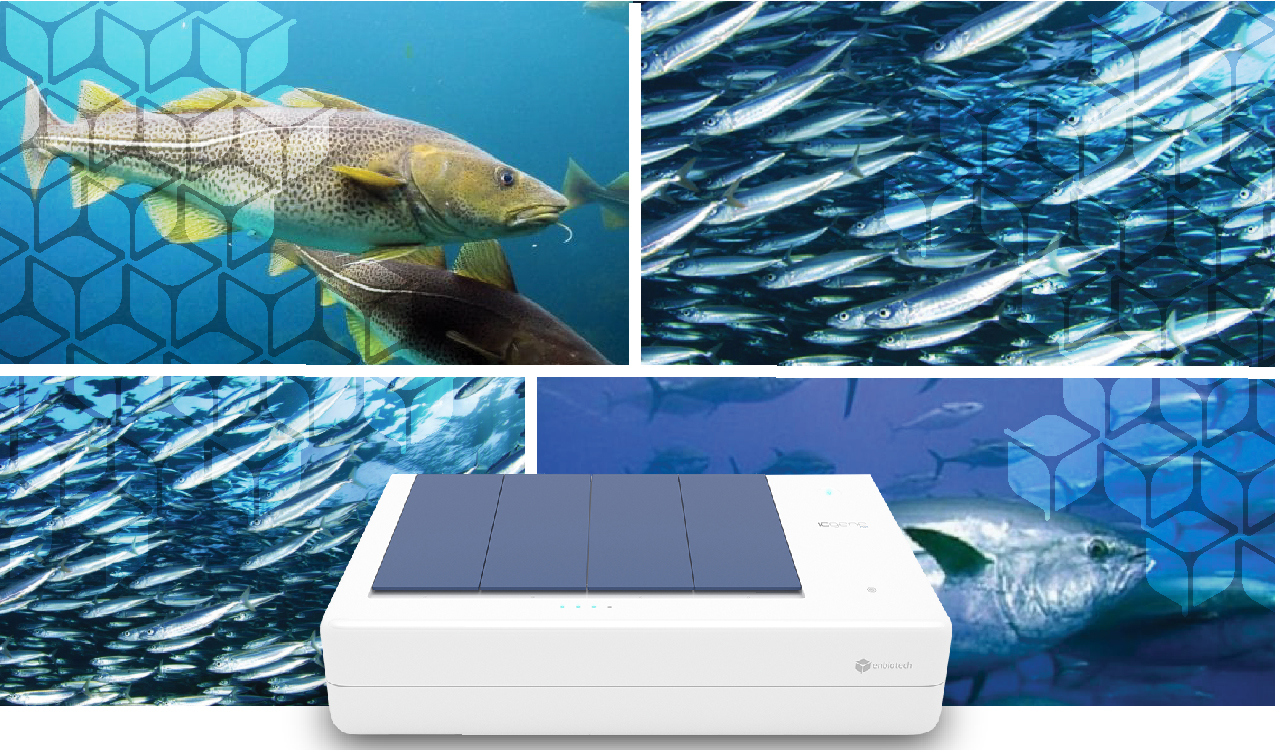
Changing eating habits in recent years, with increased consumption of raw fish products (sushi, carpaccio, etc.), have led to an increase in the incidence of parasitic infections in humans.
The most important parasite in saltwater fish is Anisakis, a whitish round worm (nematode), belonging to the Anisakidae family, which is found mainly in oily fish.
Anisakis can survive cold smoking, low-salt marinating, and refrigeration. It is killed by temperatures above 60°C for 10 minutes and by freezing (at least 24 hours at -20°C).
The disease caused by the Anisakis genus in humans is called anisakidosis.
Anisakis is present in the Mediterranean Sea as well as in the Atlantic, Pacific and Indian Oceans.
The most commonly infested fish species in Italian seas are: sardines, herring, anchovies, mackerel, gadidae, sparids, lophids, John Dory, scabbardfish (almost always infested), squid, and squid. Laboratory testing is typically conducted through direct visual inspection.
Thanks to biomolecular diagnosis, DNA analysis has made it possible to overcome all the limitations of the current investigation method.*
* G Cammilleri: “Validation of a Commercial Loop-Mediated Isothermal Amplification (LAMP) Assay for the Rapid Detection of Anisakis spp. DNA in Processed Fish Products”. Foods 2020, 9, 92 ** Licenze di brevetto WO 00/28082, WO 01/34790, WO 01/77317, WO 02/24902, WO 01/34838 *** Patent for industrial invention no. 0001425753 of 09.11.2016
To perform rapid DNA extraction and specific gene amplification with LAMP technology
Contains all information relating to the kit, including the lot number and expiration date
Con esito in tempo reale della ricerca di Anisakis spp nei campioni analizzati
The system allows automatic interpretation of the results, real-time visualization, and online availability. The sigmoid curves corresponding to the positive (+) samples indicate the presence of Anisakis spp. The straight lines indicate that the analyzed samples are negative (o) for Anisakis spp.
Specific kit for the qualitative, rapid and specific detection of Campylobacter jejuni in food matrices.

Specific kit for the qualitative, rapid and specific detection of Listeria monocytogenes in food matrices.
Specific kit for the qualitative, rapid and specific detection of STEC toxins Stx1 and Stx2 in food matrices.
 English (UK)
  Italiano
  Polski