
Specific kit for the qualitative, rapid and specific detection of Listeria monocytogenes in food matrices.



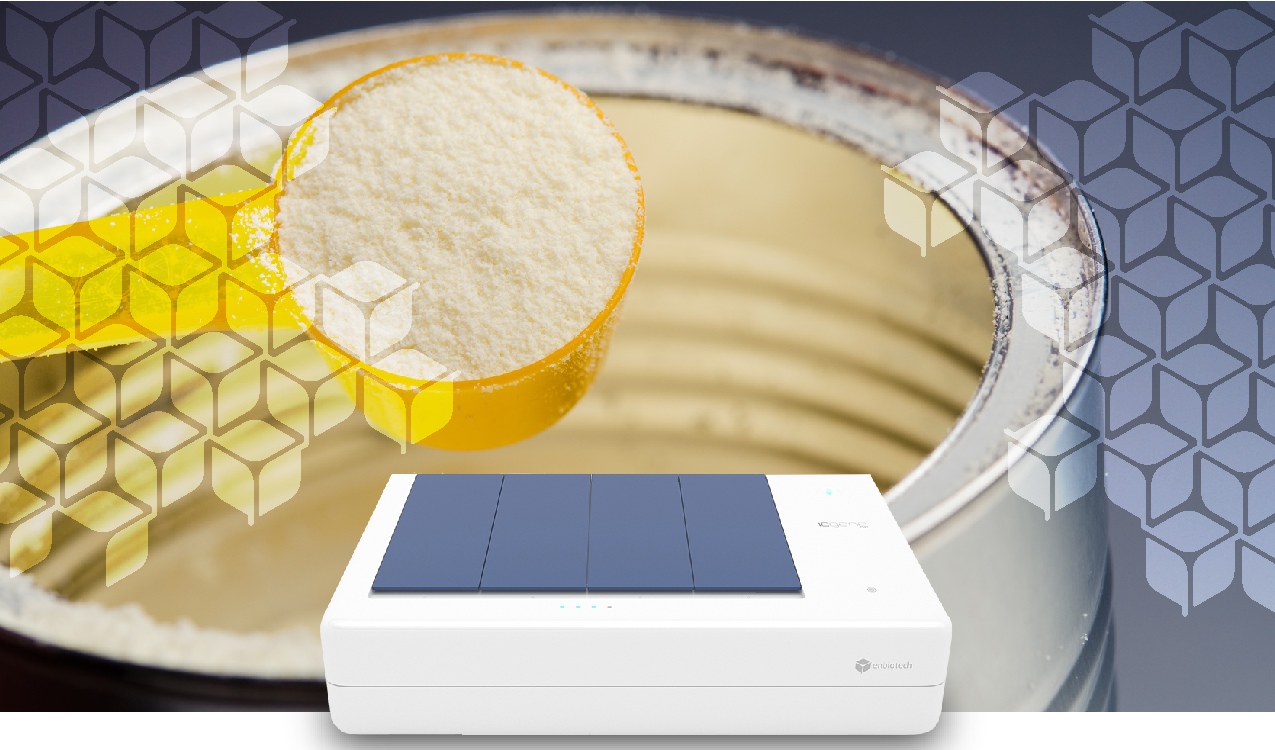
In 2007, Enterobacter sakazaki was reclassified as Cronobacter spp.
The new genus consists of six species: Cronobacter sakazaki; C. turicensis; C. malonaticus; C. muytjensi; and C. dublinensis.Cronobacter spp. have been implicated in outbreaks causing meningitis and enteritis, especially in infants.
Their natural habitat is not well understood; however, they have been isolated from a wide range of environments, such as processing plants, households, and foods, such as fermented bread and cheese.
A direct association between infection and food consumption has been repeatedly demonstrated only in the case of infant formula. Infant formula is not a sterile product and therefore may occasionally contain pathogens.
Although it undergoes pasteurization during its manufacturing process and Cronobacter spp. do not survive pasteurization, recontamination can occur during subsequent handling, namely through:
1) Raw materials and in particular heat-sensitive nutrients, e.g. vitamins, minerals, etc., added after pasteurization;
2) The processing environment, i.e. equipment and processing lines.
Cronobacter spp. do not grow in milk powder, but can survive for a long period of time and therefore become a potential risk after rehydration of the product.
*Patent licenses WO 00/28082, WO 01/34790, WO 01/77317, WO 02/24902, WO 01/34838 ** Patent for industrial invention no. 0001425753 dated 09.11.2016
To perform rapid DNA extraction and specific gene amplification with LAMP technology
Contains all information relating to the kit, including the lot number and expiration date
With real-time results of the research of Cronobacter spp in the analyzed food samples
The system allows automatic interpretation of the results, real-time visualization and online availability. The sigmoid curves sigmoid curves in correspondence with the positive (+) samples indicate the presence of Cronobacter sppThe straight indicate that the analyzed samples are negative (or) for Cronobacter spp.
Specific kit for the qualitative, rapid and specific detection of Listeria monocytogenes in food matrices.

Specific kit for the qualitative, rapid and specific detection of Salmonella spp. in food matrices.

Specific kit for the qualitative, rapid and specific detection of Anisakis spp. in food-grade fish products, fish, nematodes and larvae.
 English (UK)
  Italiano
  Polski